home

'Prayer' Posts

Message to the World – The Power of Prayer

Thursday, July 8th, 2010 - Bracha Goetz

Imagine you’re in a room full of Jewish addicts. And you’re volunteering to lead a group on Tuesday evenings. The group is called “Spirituality.” What would you talk about?

This week I decided to ask them what they would talk about. I tossed out a question that I had heard a rabbi ask at the time the Super Bowl was happening, about creating one’s own super bowl ad. “What message would you want to give to the world in thirty seconds if you had a chance to speak to 100 million people?” I asked. They loved it!

With my arm outstretched into a closed fist (a mike), I walked around holding it in front of each resident of the Jewish Women’s Recovery House, as she spoke. Leslie, twenty-four, had been in the recovery house for almost four months since she got out of jail after her last DUI. She was very eager to respond. “Here’s what I’d say!” she exclaimed enthusiastically. “If you radiate positive energy into the world, that’s what you’ll attract. If you give off negative energy – that’s what you’ll attract!” I told her she had a few more seconds before her thirty seconds would be up, so she elaborated just a little bit more, and just as excitedly.

Next Rosie wanted “the mike.” Rosie, thirty-five, and a registered nurse, had only been in the recovery house for a week and a half after being released from a local psychiatric hospital. “I started reading a book I found by a Rabbi Twerski. Here it is!” she said, picking it up from the couch, right next to her. “It’s called Angels Don’t Leave Footprints: Discovering What’s Right with Yourself. And I only started it, but it says that we are really better than angels because we can change and grow. We each have a piece of G‑d inside of us. It just gets covered up, but there’s always hope that we can come to recognize who we really are.”

Ellen, forty-one, a publicist, had come from a detox facility after getting clean from heroin. She had also not been in the house for a full two weeks yet. Ellen waited patiently for everyone else who wanted to speak to go before her, but when her turn came, she was just as ready to share her message as were all the others. “I’ve learned that G‑d hears us. The answers G‑d gives us in life, they may not be the ones we wanted to get, but who are we to know what’s ultimately good for us? It can sometimes be a very long road until we really accept that.”

Then, I don’t know how or why, but all of a sudden it hit me! “I just realized something! I practically shouted. Your words – the words that each of you just spoke here – they really did reach 100 million people – but they reached even more than 100 million people!” They were all looking at me like I was nuts. “They reached everybody in the whole world!”

“Your words, your messages to the world … they sounded like prayers to me,” and my voice started cracking. “You have so much. You are such enlightened souls from all you’ve been through.”

I had to keep going. “You’ve heard of the butterfly effect, right? In the physical realm, the flapping wings of just one butterfly can create tiny changes in the atmosphere, but those tiny changes can end up eventually altering the path of something like a tornado! In the spiritual realm, our individual prayers travel far and wide – they don’t stay put within these walls – prayers don’t care about walls – they go right through them! A tiny prayer’s vibrations travel all around the world, way faster than the speed of light! So your words, your prayers, really could havereached everybody in the whole world already.”

There was complete stillness, and a glow in the room. “Yeah,” smiled Rosie. “I guess they really could have.”

Did you get the messages that these women sent you last Tuesday night? I’m sure you did, in some way. It could have reached you in a ray of hope you felt in one flash of an instant.

But just in case the flapping of their beautiful fragile wings was imperceptible, now you have this.

Bracha Goetz is the author of twelve Jewish children’s books including Remarkable Park , The Invisible Book and The Happiness Box.

The content in this page is produced by Chabad.org, and is copyrighted by the author and/or Chabad.org. If you enjoyed this article, we encourage you to distribute it further, provided that you do not revise any part of it, and you include this note, credit the author, and link to www.chabad.org. If you wish to republish this article in a periodical, book, or website, please email permissions@chabad.org.

The Book of the People – The ArtScroll Siddur at 25

Monday, November 23rd, 2009 - Ron Coleman

Assuming I must have missed something — something that would be hard to miss, but stranger things have happened — I did a Google search before I wrote this article:

ARTSCROLL SIDDUR ANNIVERSARY — nope. Too narrow?

ARTSCROLL ANNIVERSARY … Nope.

For all practical purposes, at least as far as I can tell, the 25th anniversary of the publication of the first edition of the Artscroll Siddur has gone unremarked.

In a way, this is of a piece with the fundamentally restrained, dignified style of Mesorah Publications. It is also consistent with the central theme of their incredible endeavor, a perspective from which 25 years is, in the scheme of things, pretty small potatoes, and in which the publishers and authors of the Artscroll “series” (really an undertaking far greater than a “series”) see themselves as conduits of something far greater than themselves.

But we can do it for them, and not only because 25 years is, in our individual lives, a very significant amount of time, but because the publication of the Artscroll Siddur in 1984 literally turned a page in the history of the Jewish people.

In a time when more Jews were more ignorant of their heritage than ever before, and more in danger of disappearing from the nation of Israel as identifying Jews in no small part because of the inaccessibility, mystery and intimidation of the tradition, Artscroll fulfilled the dictum in Pirkei Avos, “In a place where there are no men, strive to be a man.” A man was needed; more than one, in fact; but fundamentally two — Rabbis Meir Zolotowitz and Nosson Scherman — stepped forward and took the responsibility to do the work.

For all the sweat, heart and brain that was poured into the Artscroll Siddur by these men and those who worked with them, I cannot believe that they could have had an inkling of just how phenomenal this work would be, and how much it would mean to people such as you and me.
Of course they must have realized that never before had the traditional Jewish liturgy — including the full range of responsibilities of a Jew besides “merely” understanding the words of prayer found in any bilingual siddur — become so completely accessible to so many seeking access. They knew that, even if it was not perfect, no more comprehensive, approachable siddur had ever been published in the vernacular for non-scholarly use in the home and synagogue. And they cannot have been unaware of at least the possible “political” impact this assertive broadside from the once-quiescent English-speaking community of strictly orthodox or “yeshiva” Jews would have on the course of Jewish communal and religious life for a generation.

But they could not have realized what it would mean to us to find out that, yes, there is one — there is a book — a siddur — there is one work you can buy that will tell you how to do it: How to go about being really Jewish in prayer and, in no small measure, throughout the day. When to stand in shul; when to sit; what to answer; when to bow, and in which direction — all those mysteries that, observed in our peripheral vision, kept so many of us, too self-conscious or proud to look like complete dorks in an orthodox shul or to require the embarrassing personal tutelage of an insider to even consider stepping through that door.

Now we could learn how to do it, and to some degree why we were doing it, and how much more we had to do, at our own pace; in private; and on an adult level.

This was a gift of freedom that I can hardly imagine Rabbis Zlotowitz and Scherman could have understood they were giving so many of us.

The Artscroll Siddur turned 25 last August, quietly. But the voices it enabled, empowered and amplified — hundreds, no, thousands of Jewish spirits — have not only filled the Heavens with a magnificent raash gadol [great noise] for 25 years, but have unleashed an eternity of song for which so many of us and our descendants will always be grateful.

Thank you, Artscroll.

Powerless

Tuesday, May 29th, 2007 - Rabbi Max Weiman

What would you do if you were one of the world’s greatest magicians? No, not like David Blaine and slight of hand type magic, but real magic. Would you sell your abilities to become wealthy? If you knew God blessed you with these abilities would you use them to do something He didn’t want you to do?

Is there real magic?

The forces of power in the world are created by God and some people have figured out how to tap into them. We often find that which we desperately seek. Many of us are curious, fascinated, or skeptical of strange powers, ESP, psychics, or people into real magic. But some people strongly gravitate towards impure forces, and try in many ways to acquire unusual abilities. Others are merely “blessed” with these abilities.

Everything in life is a test and a challenge. In the areas of normal human behavior we have lots of challenges. Relationships, work, honesty, love, a lifetime of spiritual struggles follows all of us around. Along with life’s struggles comes challenges and difficulties that we don’t relate to as a spiritual task, but rather merely a hurdle from the natural world. We wish we could magically avoid or overcome the hurdle. Is this the fascination with Super Heroes like Superman and Wonder Woman? Do they help us vicariously enjoy the world through the fantasy of extra abilities?

Bilaam, the ancient sorcerer

Bilaam was one man who had special abilities and those talents merely allowed him to do more spiritual damage and become more of an egotist. His self-worth was so large that he thought he deserved the royal treatment. In Numbers Chapter 22 we see a person who appears on the outside to righteous and only want to do what God wants. Yet we see how easily he is lead to do that which we know God doesn’t want. How come? Because it’s all a show. He really doesn’t care about God, even though he recognizes Him as the source of his blessings. He is blinded by honor and gifts.

This is precisely the danger of special abilities. The stronger you are, the more people you have the power to help and to hurt.

As human beings we have incredible abilities that largely go untapped. And all the more so we are able to ask the Almighty for assistance that we lack in many areas. We are able to ask God to save our life, heal the sick, stop a war, and He often answers our prayers.

One request remains as one of the most important and often forgotten. That request is for the ability to use whatever blessings we receive only for the good. Let us not fall into the trap of using our blessings to go away from our Benefactor. What would be more of an insult to Him than that?

Baalei Teshuva often have blessing they were given because of the circumstances of their upbringing. Some want to ignore these blessings. Some are embarrassed about them. Some give them up as if they are tainted.

Nothing is an accident. If you feel like there’s something wrong the way you grew up and therefore there’s something wrong with the blessings you possess, you may be correct. But you may also be very incorrect. It might even be an extreme lack of appreciation to God to ignore or reject the blessings you have.

An alternative to shunning our blessings is to pray for assistance to use the blessings correctly.

God still runs the world

As one sage once put it, “God runs almost everything in the entire world. And the last bit left.He also controls.”

Even with all of his abilities, Bilaam was still unable to curse the Jewish people, as Balak, the king wanted him to. It wasn’t for lack of trying. He did his best, but when he opened his mouth to curse, God put in his words a blessing.

A person can point a gun, but if the Almighty really doesn’t want the victim to die, they’ll survive, or the bullet will jam, or the shooter will miss. There are so many ways for Him to circumvent the plan of the killer. Its part of the plan of life that the Almighty gives us free will and doesn’t force us into doing mitzvos or avoiding transgressions. But that doesn’t mean if He really wants to stop something from happening He can’t. He can and He does, often.

The real thing

Why did Balak choose Bilaam to hire to curse the Jews. Because he recognized their true power lies in their mouths. Prayer is the true power of the servants of God, so Balak looked for someone else who had the power of the mouth to fight them.

Our power is prayer. That’s what helps us the most because with prayer you can tap into the power of the Almighty. With His help, is there anything you can’t accomplish?

Don’t waste your time with minor powers like magic, ESP, and psychic abilities. Develop the power of prayer and you can have the world in the palm of your hand.

Every Today is Another Chance to Get Things Right

Thursday, December 28th, 2006 - Maya

I saw this slogan on a bus while walking to work. Often, you don’t find interesting slogans like this on a bus. Where did the quote come from? You might be surprised if I tell you it’s from a TV show. The TV show is called ‘Daybreak’ and recently premiered on. The premise of the show is that the main character is framed for a murder and his family is in danger. Every morning he wakes up and has to repeat the same day and has to find out who framed him for the murder and he has to keep his family safe. Until he solves the mystery, the day will keep repeating itself.Upon further reflection, this quote is a great way to approach tefilla. After almost 5 years of taking classes at various Jewish outreach groups in the city, I made some breakthroughs this year and decided it was time to take some steps towards becoming more observant than in previous years when I had balked at such an idea (perhaps this will be the subject of a future post). One of the things I did was go to Israel for two weeks in July and learn at She’arim, one of the wonderful womens’ seminaries in Jerusalem. It was a transformative two weeks and the only regret I have was that I wished I had stayed a little longer. After coming back from Israel, I started davening twice a day. Before Israel (BI), I prayed for 15-20 minutes in the morning, semi-rushed because I slept in until 8:00, sometimes 8:15 and I needed to be at work at 9:00. After Israel (AI), I find myself getting up at 7:20-7:30, and davening for 30-40 minutes (my mornings are so much calmer now) and also davening Mincha. (more…)

A Miss is a Mile – Old Tehillim Found Open to Psalm 83 (or perhaps 84)

Friday, July 28th, 2006 - Guest Contributor

By Chaim Grossferstant

Let me begin by making an admission. I am not a card carrying member of the “alert Hanoch Teller immediately” crowd and am somewhat skeptical of “visionaries” who sense Hashgacha Pratis everywhere. It’s not that I don’t believe that Hashgacha Pratis exists everywhere; it’s just that I think that the maintenance of our free-choice is set up in such a way that we should be mostly oblivious to Hashgacha Pratis most of the time.

But there is a recent news item that really causes a thinking Jew in these perilous times to pause and ponder. Yesterday, the New York Sun reported (page 9) that on Tuesday Irish archaeologists discovered an ancient book of psalms spotted by a construction worker while driving the shovel of his backhoe into a bog. (Parenthetically there are a number of blogs I’d like to drive the shovel of a backhoe into!) What we would call a “Tehillim”, it is a Psalter and has been approximately dated to the years 800–1000 A. C. E. Pat Wallace, director of the National Museum of Ireland described it as “really a miracle find.”

But what makes the find of particular interest to people who are Jewish but not necessarily archeologists is that the book was found open to a page describing, in Latin script, Psalm 83, in which, according to the AP, “G-d hears complaints of other nations’ attempts to wipe out the name of Israel” and that in effect, the Psalter cannot be moved from that page. Because “It could take months of study just to identify the safest way to pry open the pages without damaging or destroying them.”
(more…)

Starting Off on the Right Foot

Wednesday, March 29th, 2006 - David Linn

It seems to me that Borchi Nofshi, Psalm 104, which is said on Rosh Chodesh mornings might just be the most overlooked section of our prayers. By the time we finish Hallel, leining and mussaf (if you are davening ashkenaz) you are probably already late for your train/bus/car pool and Borchi Nofshi often gets short shrift.

Add to that the fact that Nissan is probably the most hectic month of the year (in case you are wondering why, you better start your Pesach cleaning NOW!). Therefore, it just might be that the Borchi Nafshi we say tomorrow may not get the proper attention it deserves.


(more…)

Getting the Proper Focus

Monday, March 20th, 2006 - David Linn

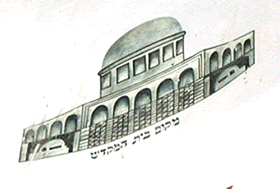
Abuhav Synagogue The Abuhav Synagogue in Tzefas, Israel is one of the most beautiful shuls I’ve been in. It is ornately painted and was constructed along the theme of the Pesach song Echad Mi Yodea (Who Knows One?) .

On top of the bima where the shaliach tzibur (prayer leader) stands is a dome, with many paintings upon it. Directly in the sight of the shaliach tzibur is a painting with the title “Makom HaMikdash” (the site of the Holy Temple). The weird thing is that the painting does not depict the Beis HaMikdash at all. Rather, it depicts the mosque that currently sits on top of the temple mount. The explanation is that when the shaliach tzibur looks up he sees that, because of senseless hatred among the Jews, in the place of the Beis HaMikdash now stands a mosque. This should serve to focus the shaliach tzibur, who represents the entire kehillah (congregation), on an all-encompassing love for all Jews.

Share the love.

Remedies for Spiritual Freeze

Wednesday, February 15th, 2006 - Rabbi Lazer Brody

Dear Rabbi Brody,

I don’t feel any kind of emotion when I go to synagogue. Praying seems to be a drag, and I feel nothing. I want to be a proper BT, but I just can’t seem to pray. What should I do?

Thanks, FR from New Jersey

Dear FR,

The old Novardok Yeshiva remedy for firing up a person with your problem is to say the prayer “Nishmas kol chai” from the Shabbos morning service; you can say it at any time or at any place, and it works wonders. Say each word slowly, loudly, and with fervor, as if you’re counting one-hundred dollar bills. If you don’t understand the Hebrew, say the translation from an English prayer book, then go back and say the Hebrew. Contemplate every word. By the time you’re through, you’ll have thawed out. Normally, when a person says “Nishmas” like he/she should, he/she kindles a bonfire of love for Hashem in their heart.
(more…)

    About Us

    Beyond Teshuva is focused on providing ideas, connection and support for Baalei Teshuva in their continuing quest of learning, growing, and giving.
    Email us at beyondbt@gmail.com

    Get BeyondBT Via Email

     Step 1: Enter your Email